
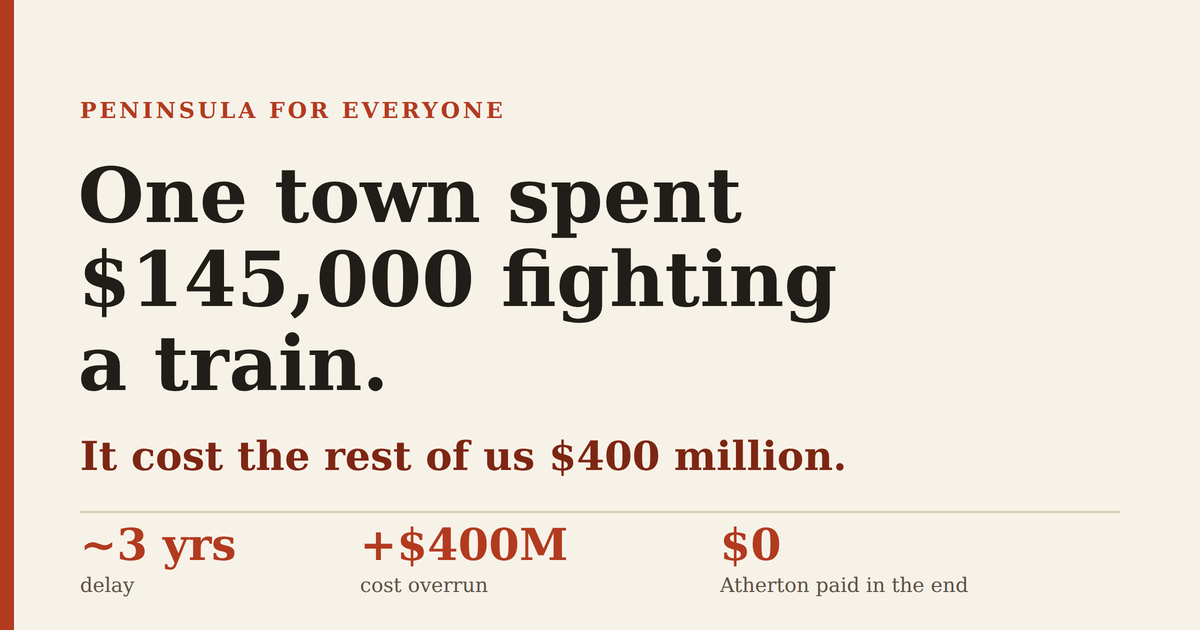

Caltrain's new fleet of electric trains finally began carrying passengers up and down the Peninsula in September 2024 — quieter, faster, cleaner, and a genuine win for the region. But they arrived years late and hundreds of millions over budget, and a big share of that delay traces back to a single town of fewer than 7,500 people where the median home price is ~$8 million.
Here is the short version. In 2012, Caltrain budgeted its electrification project — the backbone of the Peninsula's transit future and a prerequisite for high-speed rail to ever reach San Francisco — at roughly $1.5 billion. By 2017 that number had ballooned to $1.9 billion. In between, the Town of Atherton sued.
What Atherton actually did
In February 2015, just as the project cleared its environmental review, Atherton filed a lawsuit under the California Environmental Quality Act (CEQA). Its objections were, at bottom, aesthetic: overhead wires would require removing trees, and the poles would be visible from town. Read the lawsuit filing in full. The town argued Caltrain electrification and high-speed rail were really one project that should have been reviewed together — a procedural argument designed to force the whole thing back to square one. (Atherton was the lead and public face of the suit; two advocacy nonprofits joined as co-plaintiffs, all represented by the same attorney.)
Caltrain didn't stop work, but it couldn't move forward either. The Federal Transit Administration would not commit to the ~$647 million federal grant the project needed while the lawsuit hung over it. Construction procurement and federal funding applications were frozen by the legal risk. Crucially, the delay pushed the federal funding decision out of the Obama administration and into the incoming Trump administration — which then sat on the grant for months in 2017 as congressional Republicans lobbied to kill it outright. The project came within days of losing its construction contracts before the grant was finally released that May.
In September 2016, the court threw out Atherton's suit in its entirety. Judge Barry Goode rejected the central claim flatly, writing that the electrification project "can be implemented successfully even if the HSR project never takes another step forward." Caltrain made no concessions to the town as a result of the case.
But by then the damage was done.
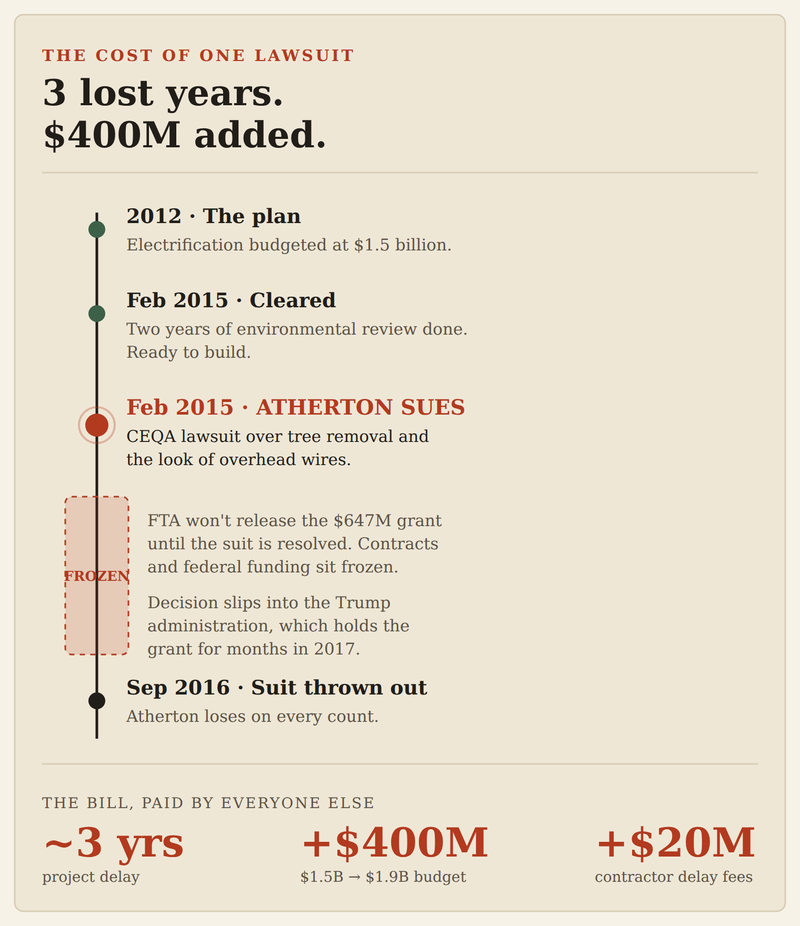
Because the project was stalled, Caltrain was forced to pay higher material and labor costs by the time it could actually build, plus roughly $20 million in direct delay payments to contractors. Those escalations then opened new funding gaps, which created their own delays — the vicious cycle that makes every stalled infrastructure project more expensive than the last.
Atherton lost in court, but they won by making the project so slow and expensive that the loss didn't matter.
They lost. So why did it still cost us $400 million?
Did Atherton get what it wanted? No. The trees came down, the wires went up, electric trains run today, and the town won no concessions when the case ended. If the goal was to stop electrification, Atherton lost.
Atherton didn't have to win. A CEQA lawsuit doesn't need a strong legal theory to do damage — it just needs to introduce enough risk that funders freeze and clocks keep running. The delay is the weapon.
A town of a few thousand of California's wealthiest residents, spending less than the price of a Peninsula starter home, imposed hundreds of millions in costs on millions of transit riders and taxpayers who never got a vote in Atherton.
This is the same dynamic playing out across the Peninsula right now on housing, on bike lanes, on bus service, on street redesigns that would keep people from being killed in traffic. While names and procedural hooks change the structure does not: a small, organized, well-resourced minority uses process to veto things the broader public needs and the cost is hidden from the broader public and time we can't get back.
Caltrain electrification was worth fighting for, and it won — but the three years and $400 million Atherton cost us are exactly the kind of damage that erodes public faith that government can deliver at all.
The good news is that California's legislature noticed. In 2024, prompted directly by this fiasco, California passed AB 2503, exempting rail electrification on existing right-of-way from the CEQA reviews that Atherton exploited. One veto point, closed. There are many more.
Peninsula for Everyone advocates for housing, transit, and vibrant public space across the San Francisco Peninsula. The decisions that shape your commute, your rent, and your streets are made by your city council — and they're watching who shows up.
Sources
- Californians for Electric Rail, "How Environmental Law Holds Back Cleaner & Better Rail | Part 2: Atherton vs. Caltrain Electrification" — link (cascade, $1.5B→$1.9B, $20M delay costs, Sep 2016 ruling).
- Green Caltrain, "Bill proposes CEQA exemption for rail electrification" — link (three-year delay; $400M cost increase; AB 2503).
- High Speed Rail Alliance, "How California Overcame a Major Barrier to Rail Electrification" — link (19-month litigation; funding pushed into Trump administration).
- The Almanac, "Atherton loses lawsuit over Caltrain electrification project" (Sept. 28, 2016) — link (ruling; co-plaintiffs; no concessions).
- Contra Costa County Superior Court, Town of Atherton v. PCJPB, Opinion and Order (Sept. 26, 2016) — PDF (Judge Goode's findings).
- The Almanac, "Atherton may sue, again, over high-speed rail" (Nov. 2016) — link ($145,550 total spending; ~$22,415 in legal fees).
- Palo Alto Online, "Federal funding halted for Caltrain electrification" (Feb. 17, 2017) — link ($647M grant held).
- San Francisco Examiner via Sen. Hill's office, "Federal funding zaps Caltrain electrification back to life" (May 2017) — link (grant released).